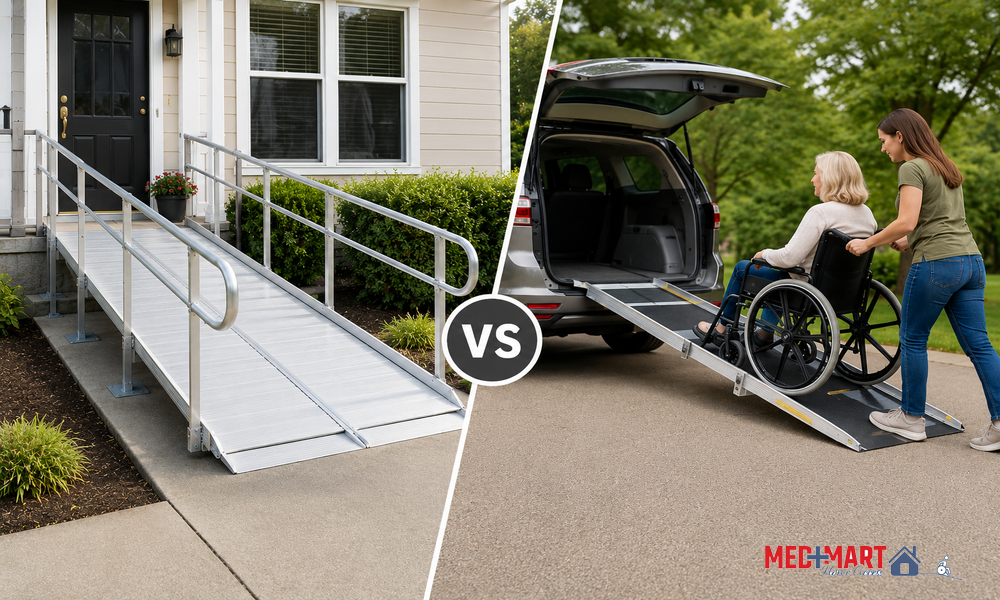
Home safety is one of the most important factors for those using a wheelchair or a mobility scooter. Raised entrances or steps make mobility even harder for people with mobility challenges. However, the entire scenario changes with a good and reliable wheelchair ramp. It gives people back the ability to move around freely in their home on their own terms and reduces dependency on caregivers every time they step outside.
When selecting the right type of ramp, there are a few things you want to consider. The market has endless options, among which are modular and portable ramps. Although both serve the same purpose, they are built to suit very different situations.
This is where Med Mart Home is here to make a difference. As a prominent medical supply and equipment store serving Cincinnati and Dayton, Ohio, we offer mobility products, wheelchair ramp installation, accessibility solutions, and more to serve your immediate mobility needs.
Understanding Wheelchair Ramps
Ramps are inclined surfaces built to assist wheelchair users, seniors, and individuals with mobility limitations to move around freely and safely. These solutions enhance accessibility across homes and support regular movement.
Today, most medical supplies and mobility equipment are designed to enhance comfort, accessibility, and independence. Wheelchair ramps are one of the most important accessibility solutions that assist in creating safer and barrier-free access across home care settings.
So, before we dive into the main comparisons, let us understand what each type offers.
What Are Portable Wheelchair Ramps?
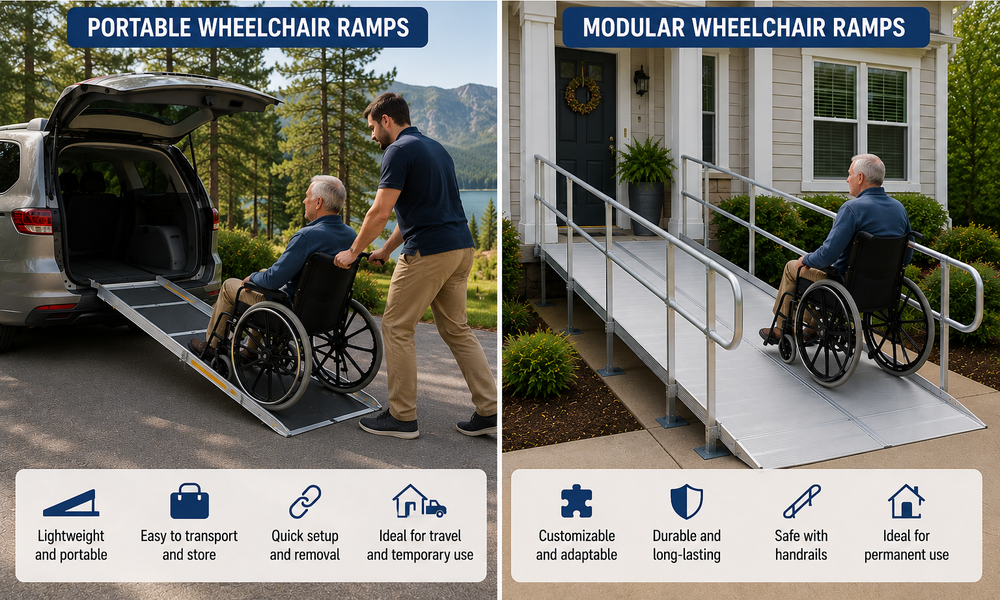
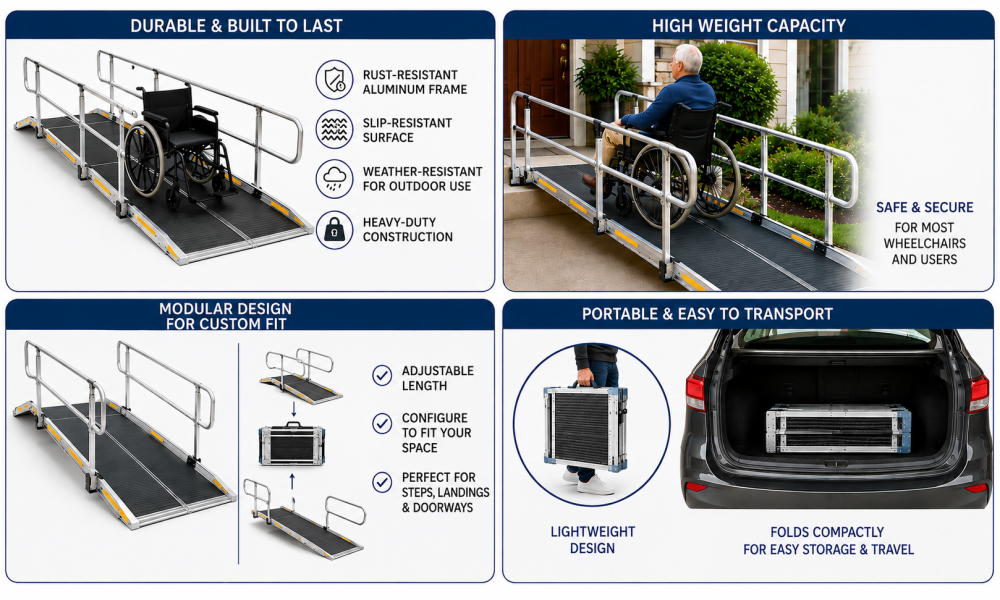
Portable wheelchair ramps are ramps that are temporary. The majority of them are easy to carry and store by folding or separating into parts. These ramps are usually constructed using aluminum since it is durable, resists rust easily, and is lighter to carry.
Portable ramps are often used for:
- Minor steps and door accesses
- Entering vehicles
- Temporary recovery situations
- Travel and outdoor activities
- Homes with no stable accessibility solutions
Portable ramps are favored by many caregivers as they can be installed in minutes and removed when they are not in use.
What Are Modular Wheelchair Ramps?
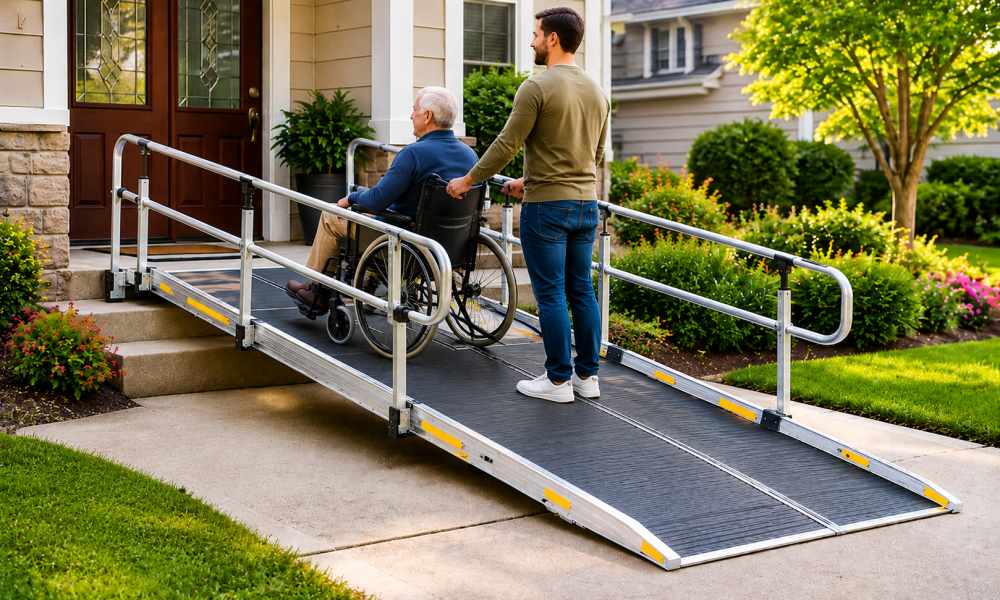
Modular wheelchair ramps are temporary accessibility ramps constructed using several joined parts. These are placed on the ground and tailored according to the height, layout of the entrance, and available space. These ramps can be equipped with handrails, rotating platforms, and resting landings to make their use safer on a daily basis.
Modular ramps are commonly chosen for:
- Long-term accessibility needs
- Multi-step homes
- Seniors who use wheelchairs or walkers regularly
- Medical facilities and healthcare settings
- Outdoor entrances that need stable access
The modular systems are designed to be used on a regular basis and offer better support and stability than portable ramps.
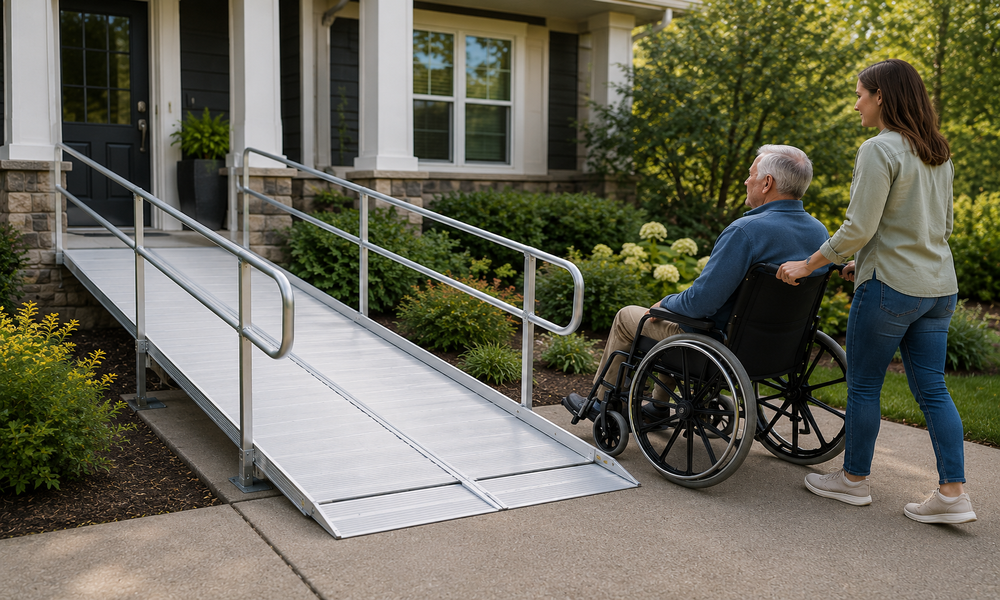
Modular vs Portable Wheelchair Ramps: Key Differences
Understanding both ramp types can help you identify the right option that aligns with your existing mobility needs.
|
Main Features |
Modular Wheelchair Ramps |
Portable Wheelchair Ramps |
|
Primary Function |
Long-term access to residential buildings |
Short-term use or travel-based |
|
Installation Needs |
Professionally installed and fixed on-site |
Can be assembled, DIY |
|
Portability |
Remains fixed post installation |
Foldable and easy to carry |
|
Durability |
Sturdier option ideal for frequent use |
Only for optional use |
|
Customization |
Tailored according to your space and convenience |
Available in standard sizes only |
|
Weight Capacity |
Efficient in handling heavy-duty mobility aids |
Lower to moderate weight limitation |
|
Storage |
Not designed for carrying or storing |
Foldable and easy to store |
|
Cost |
Higher and more expensive upfront cost |
Budget-friendly option |
|
Ideal For |
Homes, offices, or long-term accessibility |
Travel, vehicle use, and temporary accessibility |
Now, let us dive into the details:
Installation and Setup
Modular Ramps
The modular ramps are to be assembled and installed by professionals. Since they are made up of sections, they can be safely installed with the right slope.
Pros
- Stable and secure
- Long-lasting setup
- Good at dealing with greater heights
Cons
- Higher installation effort
- Requires designated space
Portable Ramps
Portable ramps do not involve much or any installation. It can be unpacked and assembled without any extra tools.
Pros
- Ready to use immediately
- No permanent modifications
- Easy to move
Cons
- Less stable on uneven surfaces
- Limited for greater height variations
Durability and Weight Capacity
Modular Ramps
Modular ramps are constructed to carry regular daily usage and can be used under harsh outside conditions. They endorse greater load abilities and heavy-duty mobility aids.
Portable Ramps
They are not considered regular ramps since they are planned as temporary ramps.
Portability and Convenience
Modular Ramps
Modular ramps are fixed and are not meant to be moved once they are installed. They may be disassembled or moved, but require more effort than a portable ramp.
Portable Ramps
These ramps excel in terms of portability. They fold, and the user can take them to their vehicle, where they can be used temporarily or during a trip.
Cost Comparison
Modular Ramps
Modular ramps may prove to be quite expensive due to:
- Larger materials
- Custom configurations
- Professional installation
However, it is a long-term substitute that can be value-producing in the long run.
Portable Ramps
Portable ramps are less expensive and can be rented.
Accessibility and Safety
Modular Ramps
The modular ramps usually include:
- Handrails
- Non-slip surfaces
- Wide platforms
- ADA-compliant designs
Portable Ramps
- Do not have a handrail option
- Non-slip surface
- For every 1 inch of rise, 1 foot of ramp is needed to be ADA compliant
Space Requirements
Modular Ramps
Modular ramps are considered permanent structures, although they can be moved if needed. These ramps consume more space and require installation and thorough planning.
Portable Ramps
Portable ramps are compact in design and are easy to store when not in use.
Which Wheelchair Ramp Should You Choose?
The process of selecting the appropriate wheelchair ramp option depends primarily on the circumstances.
Choose a Modular Wheelchair Ramp If:
- You want a long-term accessibility solution
- Your premises must be covered by ADA regulations
- When safety and stability are the greater concerns
- Cases when the ramps are shared by more than one user
- When you have to overcome larger height differences
Pro Tip
When deciding to invest your money in a portable ramp, it is important that you analyze the weight capacity rating, the surface of the ramp deck, and the folded size that fits in your vehicle. A ramp that has not been constructed for travel would not serve your purpose.
Choose a Portable Wheelchair Ramp If:
- You travel frequently and need help getting a power mobility device in and out of your vehicle
- Finding a short-term accessibility fix
- You require a portable, lightweight product
- You do not have the space for a permanent ramp structure
- When seeking a quick setup and removal
*A Note on Safety Standards and Compliance
Whichever kind of ramp you buy, make sure it meets safety standards. The ADA provides specific criteria for surface texture, slope ratios, and handrail height. Residential ramps do not have to conform to these guidelines legally. However, using them as a benchmark is the best idea. Find ramps with posted weight capacity ratings, and make sure your installer is familiar with your local building codes before any installation.
For decades, Med Mart Home has provided the most trusted mobility and accessibility solutions to families throughout Cincinnati and Dayton, Ohio. We provide comprehensive installation, repair, and rental options so home accessibility can be achieved, giving you improved mobility and independence. Our tailored approach provides a solution for your mobility needs, and here is what we do:
- Free in-home consultations & estimations
- Professional-grade installations done by experienced technicians
- Consistent support through both rental and in-home repair options
- We have high online ratings, which reflect decades of reliable service
- We are dedicated to assisting families in creating a safe, accessible, comfortable home every day.
Why Families Across Ohio Trust Med Mart Home
Final Thoughts
For those relying on a wheelchair or other mobility device, all you need is the best accessibility solution. The right ramp, a properly installed lift, or an easily accessible bathroom can restore independence to someone and eliminate stress for family members. At Med Mart Home, we have solutions, decades of experience, and a local presence to help make these available for you.
Contact us today for a no-cost in-home consultation. Our team will evaluate your entire space, answer your concerns, and suggest the ideal solutions that align with your needs as well as your budget!
Frequently Asked Questions
1. Can a wheelchair ramp be used on any surface type?
Most ramps are suitable on concrete, wood, or asphalt. However, some may require extra support beneath soft or uneven surfaces.
2. How long does it take to install a modular wheelchair ramp?
A full modular ramp installation usually can be accomplished in one day by a professional crew.
3. Are wheelchair ramps covered by Medicare or insurance?
Although Medicare usually does not pay for ramps, Medicaid waivers or veterans’ programs could be helpful.
4. What weight capacity should a wheelchair ramp have?
Choose a ramp with a weight capacity that safely supports the user, the caregiver (if assisting while on the ramp), and the mobility device.